There is a particular kind of construction work that succeeds only when nobody talks about it.
The renovation of a hospital toilet is exactly that kind of work. When it is done well, patients and visitors simply walk in, use the space, and walk out. The new tiles, the quiet plumbing, the steady lighting, none of it registers consciously. That invisibility is the goal. It is also, in its own way, the highest standard a contractor can be held to.
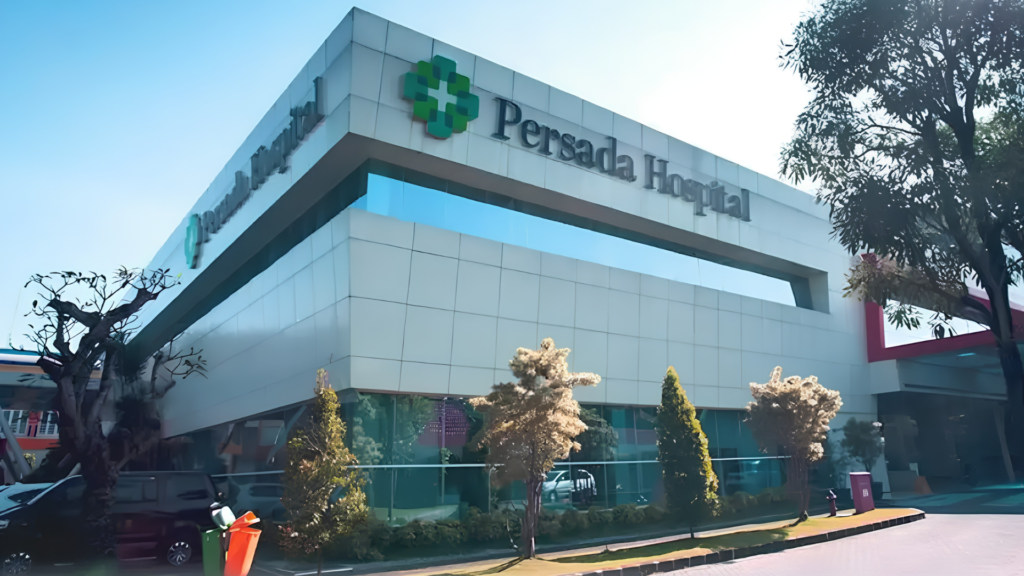
PT. Tiga Pilar Entalispro is currently delivering that standard for Persada Hospital, one of Malang City’s established private healthcare institutions. The scope of work is the lobby toilet facilities. The expectation is simple: a space that functions flawlessly, looks clean and modern, and requires no explanation.
What the Work Actually Involves
Renovating a hospital toilet is not a single trade job. It is a coordinated sequence of five distinct disciplines, each with its own technical logic, all sharing the same confined space and the same tight deadline.
It begins with demolition. Existing walls, floor ceramics, door frames, and fixtures are removed with care. Some elements are salvaged for reuse. The debris is cleared from the site entirely.
Structural and architectural work follows. New brick walls are built where needed, plastered, and finished with acian. Premium ceramic tiles go up on both walls and floors. The ceiling system is assembled from galvalum hollow frames with Calsiboard panels. A beveled Asahi mirror with stainless steel pin brackets is installed above the vanity area.
Electrical work runs in parallel. Eight lighting points are wired and fitted with Philips LED downlights. Spotlight units are positioned above the washbasin area. Switches and a power outlet are installed using Panasonic components.
Plumbing is the most technically layered portion of the project. Clean water and waste water piping systems are installed across the space. Toto closets, urinals, washbasins, shower sprays, and floor drains are fitted and commissioned. A custom granite washbasin counter is built to specification. Toilet partitions with Phenolic Compact Laminated panels, indicator locks, and door stoppers are assembled in each cubicle.
Finishing closes the project out. Jotun interior paint goes on walls and ceiling. A final clean-up returns the site to the hospital.
The Material Choices and What They Communicate
Every specification in a hospital renovation carries a message. The choice of Toto sanitaryware, for instance, is not purely aesthetic. Toto products are a standard fixture across premium healthcare facilities in Indonesia precisely because they are engineered for durability and easy maintenance. A hospital housekeeping team should be able to clean the space efficiently and repeatedly without worrying about surface degradation or fixture failure.
The same logic applies to the ceramic selections from Niro and Ikad, to the Calsiboard ceiling panels that resist moisture in humid bathroom conditions, and to the Jotun paint that holds its finish through frequent cleaning. Each choice reduces the long-term maintenance burden on the hospital.
None of these are decisions made for show. They are decisions made for the ten years after the ribbon is cut.
When the Plan Meets Reality
At some point in almost every construction project, the plan and the field conditions stop agreeing with each other. Materials specified at tender are no longer available in the market. Site conditions reveal something the drawings did not anticipate. The question is never whether this will happen. The question is how the contractor responds when it does.
For PT. Tiga Pilar Entalispro, the response was documentation and transparency. When certain specified materials were found to be out of stock, the company did not quietly swap them for whatever was available. Instead, it raised a formal clarification, presented the client with updated specifications, and documented every change with a clear explanation of what was different and why.
In one case, the water supply piping was upgraded from standard PVC to a PPR system. PPR is a higher-grade material, more commonly used in premium healthcare and commercial installations, with better pressure tolerance and a longer service life. The change was processed as an additional work order with explicit pricing. The client knew exactly what was happening and why.
By the time the budget plan reached its third formal revision, it was not a sign of a project in trouble. It was a record of a project being managed honestly.
Building Safely Inside a Working Hospital
A hospital does not pause its operations for a renovation. Patients are still being admitted, staff are still moving through corridors, and the facility is still functioning at full capacity while construction is underway just around the corner.
That context makes site safety management a different proposition than it would be on a standalone construction site. PT. Tiga Pilar Entalispro has addressed this by installing physical protective barriers around the work area using plywood and CNP steel framing, and by displaying SMK3 safety signage throughout the project site. SMK3 is Indonesia’s national Occupational Health and Safety Management System standard.
These measures exist to draw a clear boundary between the construction zone and the rest of the hospital. The goal is to make the renovation effectively invisible to everyone not directly involved in it, for the entire duration of the work.
A Small Project With a Clear Argument
Renovations of this scale rarely make headlines. The lobby toilet of a hospital in Malang is not the kind of project that appears in infrastructure investment announcements or appears on the agenda of industry conferences.
But it makes an argument that is worth paying attention to.
Persada Hospital chose to invest in this space because it understands something that more and more private healthcare institutions across East Java are coming to recognize. The quality of physical infrastructure and the quality of patient care are not separate things. They are the same thing, experienced from different angles.
A clean, well-functioning, well-maintained toilet tells a patient something about the institution before they have spoken to a single doctor or nurse. It is part of the first impression that either builds or erodes trust.
PT. Tiga Pilar Entalispro’s job is to make sure that impression is a good one. That is not a small responsibility. It is just a quiet one.