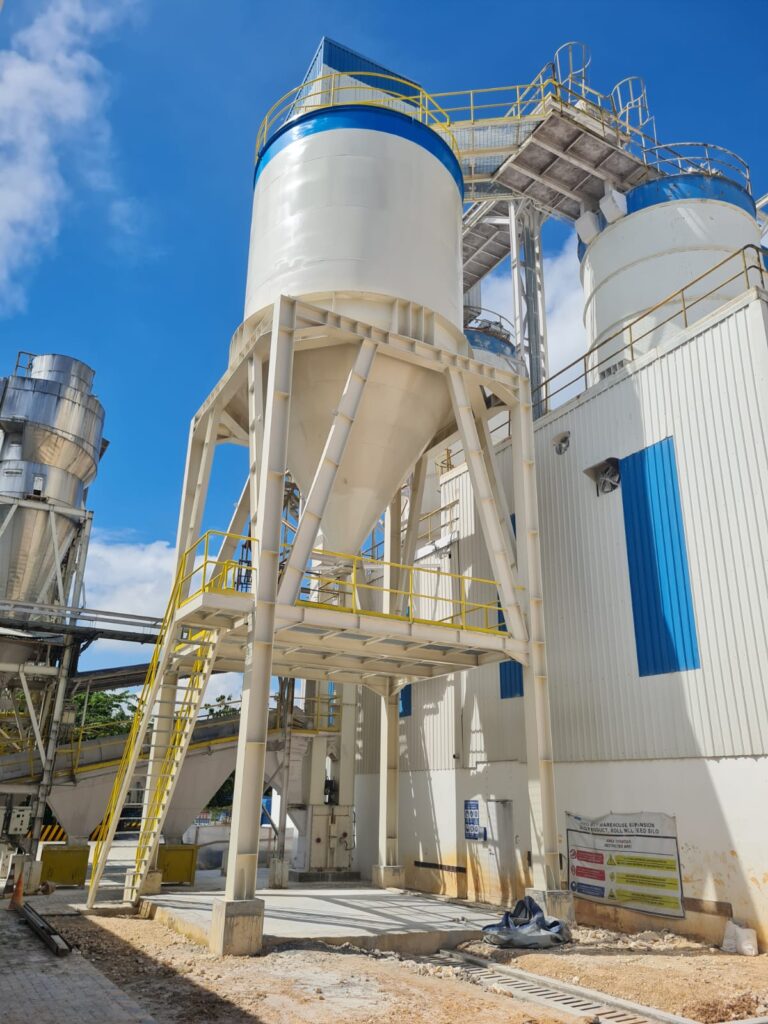
Two silos. Each capable of holding 250 tonnes of material. Built from the ground up, from pile driving to the final coat of paint.
That is the scope of work PT. Tiga Pilar Entalispro is currently delivering for PT. Omya Indonesia at its Tuder plant in Rembang, Central Java. The project covers both a Product Silo and a Roll Mill Silo, each with its own civil foundation and steel structure, engineered and fabricated as a complete package by a single contractor.
It is the kind of project that tests the full range of an EPC company’s capabilities. Not just the ability to weld and bolt steel, but the ability to design a foundation that will hold it, manage a fabrication schedule, coordinate a crane erection, and hand over a finished structure that will operate reliably for decades.
Who Is Omya, and Why Does This Matter?
PT. Omya Indonesia is the Indonesian arm of Omya, a Swiss-headquartered global producer of industrial minerals, primarily calcium carbonate and dolomite. Its products are used across a wide range of industries including paper, plastics, paints, coatings, and construction materials.
The Tuder plant in Rembang is one of its production facilities in Indonesia. Calcium carbonate processing requires precise storage and material handling infrastructure. A silo in this context is not merely a storage vessel. It is an active part of the production line, feeding material into the process at controlled rates and volumes. When a plant decides to add silo capacity, it is making a statement about where production is headed.
For PT. Tiga Pilar Entalispro, being selected to deliver this infrastructure at an international mineral processing facility is a meaningful project reference.
Two Silos, Two Functions, One Contractor
The project comprises two distinct structures, each serving a different point in the production process.
The Product Silo stores finished processed material before it is dispatched to customers or packaging lines. The Roll Mill Silo is positioned earlier in the process, holding material that feeds into the roll mill grinding system. Both are designed to hold 250 tonnes, but their structural and process requirements differ enough that each has its own engineering specification and foundation design.
Delivering both under a single contractor is a deliberate choice by Omya. It simplifies coordination, creates a single point of accountability, and allows the civil and structural work on both units to be sequenced efficiently within the same site mobilization.
Starting from the Ground: Civil Works
Before a single piece of steel is lifted into place, the ground beneath it has to earn the right to hold it.
For a 250-tonne silo filled with dense mineral material, the foundation is not a straightforward pour. Both silos require deep pile foundations driven into the soil to transfer the structural load down to stable bearing strata. Precast concrete piles are driven, their heads broken back to the correct level, and a reinforced concrete footing is cast over the pile group.
From there, the foundation system builds upward through a series of carefully sequenced elements. Pedestal columns rise from the footing, precisely positioned to receive the anchor bolts that will connect the steel structure above. The entire assembly is grouted with high-strength Sika grout to eliminate any gaps between the steel base plate and the concrete surface beneath it.
Around the foundation, reinforced concrete slabs are cast as the operational floor. These floors are not thin. They are designed to carry the weight of forklifts, conveyor equipment, and the constant movement of an operational plant. A floor hardener is applied to the surface to resist the abrasion of daily industrial use.
The drainage system, sloped beams, and backfill compaction complete the civil package before the structural team takes over.
The Steel: Fabricated, Blasted, and Erected
The steel structures for both silos are fabricated by PT. Tiga Pilar Entalispro before arriving on site. This is a critical advantage of in-house fabrication capability. The company controls the quality of every weld and every cut in the workshop, not in the field.
Each silo body is built from multiple shell rings of mild steel plate, with plate thickness varying by elevation. The lower sections, which carry the greatest load, use thicker plate. As the structure rises, the specification steps down to lighter gauges where the forces are lower. This graded approach is standard engineering practice, and it reflects careful structural calculation rather than conservative over-specification.
The cone at the base of each silo, where material flows out into the process, is fabricated from stainless steel SUS304. This is a deliberate material selection. The cone is the part of the silo that is in constant contact with the product. For calcium carbonate, which can be mildly abrasive and sensitive to contamination, a stainless steel cone ensures both longevity and product integrity.
The supporting structure for each silo is built from heavy wide-flange and H-beam sections. Four main columns carry the silo body. Girders and bracing connect them into a rigid frame at multiple elevations. Load cells are integrated into the structure at the silo support points, allowing the plant to continuously monitor exactly how much material is inside the silo at any given time.
Access platforms are installed at multiple levels on each structure, complete with galvanized grating floors, pipe railings, and kick plates. These platforms allow maintenance personnel to reach every part of the silo safely and without improvised access equipment.
Painting as Engineering
The final surface treatment on a steel structure of this type is not cosmetic. It is engineering.
Every steel component is sand blasted to SA 2.5 standard before painting. SA 2.5 is a rigorous surface preparation grade that removes mill scale, rust, and all previous coatings down to a near-white metal surface. The roughened surface profile created by blasting gives the paint system something to grip.
Over that prepared surface, a primer coat followed by a top coat is applied to achieve a total dry film thickness of 225 to 250 microns. This paint system is the first and most important line of defense against corrosion in a plant environment where humidity, mineral dust, and occasional moisture are constant factors.
A silo with a compromised paint system does not fail immediately. It fails slowly, invisibly, until the corrosion reaches a point where structural integrity becomes a concern. Specifying and executing the surface treatment correctly at the start is the decision that determines how long the structure performs without major intervention.
Erection: Where Everything Comes Together
Steel fabrication happens in a controlled workshop environment. Erection happens on a live industrial site, in real weather, with a 75-tonne crane doing the lifting.
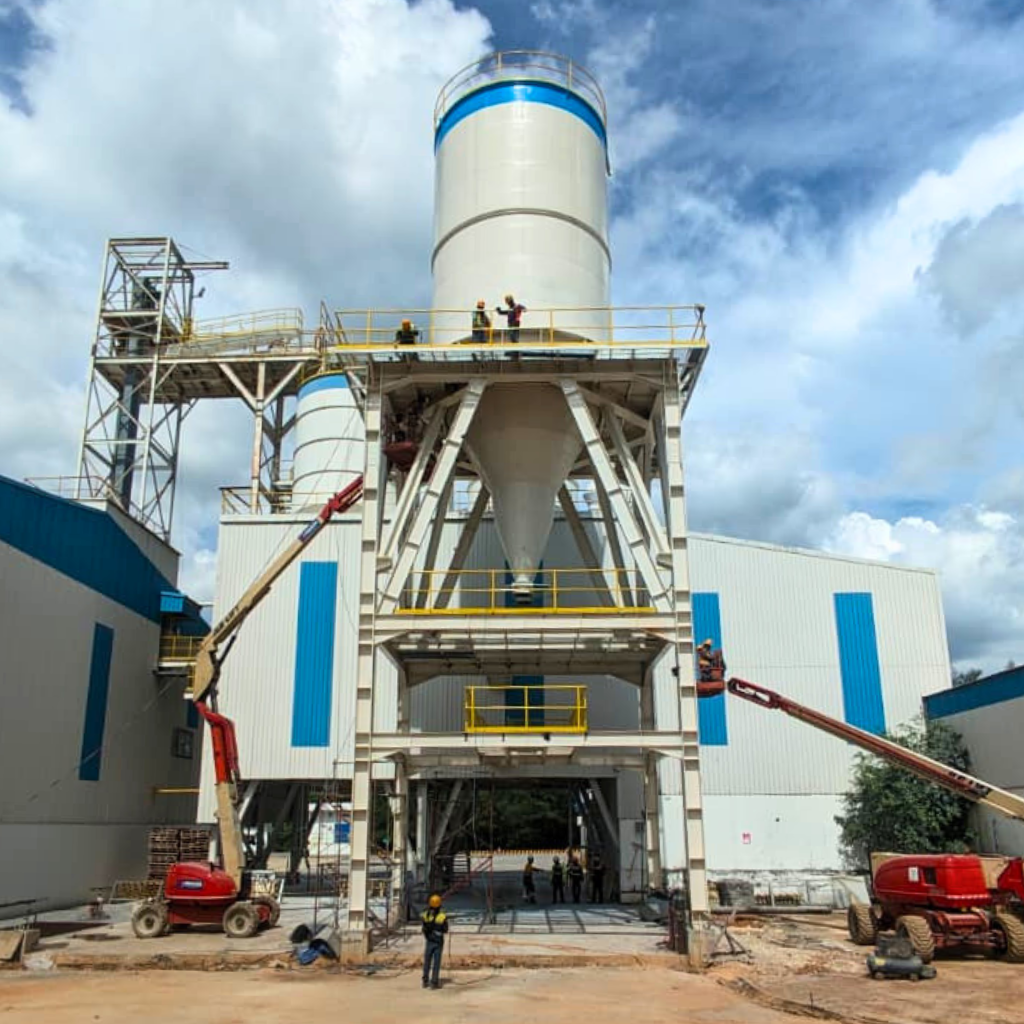
The erection sequence for a silo of this size requires careful planning. Components are lifted in a specific order. The column and base frame goes up first. Girders are connected. The silo shell rings are lifted and welded in place section by section, starting from the bottom and working upward. The cone, one of the heaviest individual lifts, requires precise rigging to land it correctly on its support ring.
Boom lifts and scaffolding support the work at height throughout the erection phase. Throughout this period, certified safety equipment and BPJS coverage for all workers are maintained as a non-negotiable baseline.
A Project That Asks for Everything
What makes this project worth attention is not the drama of a single large number or a headline-grabbing announcement. It is the breadth of what is being asked of a single contractor.
Ground investigation. Pile driving. Reinforced concrete foundations. Structural steel fabrication. Surface treatment. Heavy lift crane erection. Access platform installation. Instrumentation integration through load cells. All of it coordinated within a five-month window, at a plant that does not stop operating while the work is happening around it.
PT. Tiga Pilar Entalispro’s presence on this project reflects the kind of integrated EPC capability that industrial clients like Omya seek when they cannot afford to manage multiple contractors across a single structure. The silo either works or it does not. The contractor either delivers or they do not.
In Rembang, the steel is rising. The answer will be visible from across the plant.