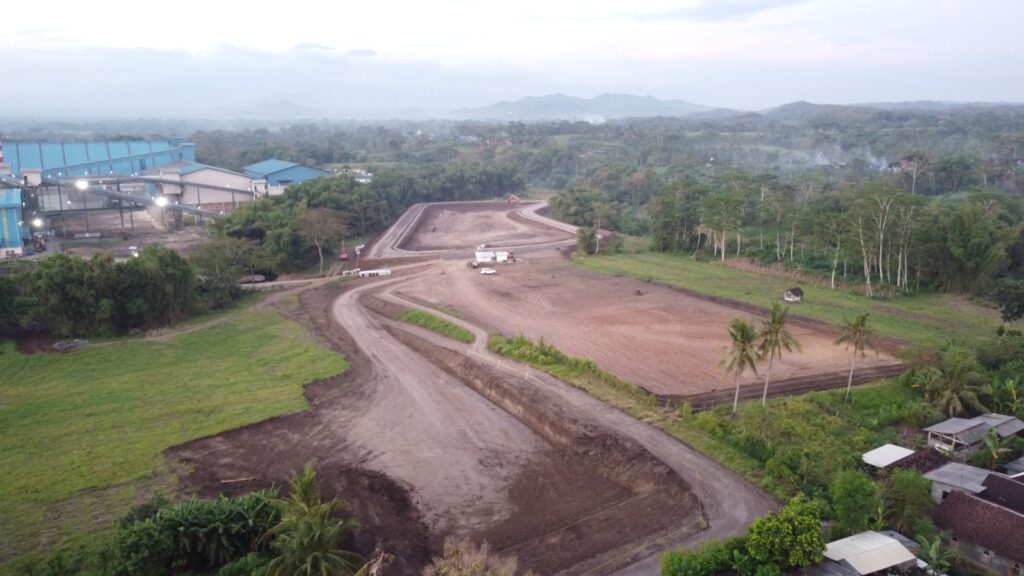
The land is still farmland right now. Rice paddies and cultivated fields stretch across what will soon become a critical piece of industrial infrastructure for one of East Java’s largest sugar processing operations.
That shift is the subject of an ongoing land clearing and levelling project being prepared by PT. Rejoso Manis Indo, a sugar factory operating in Rejoso, Blitar. The expansion is not merely a physical one. It is a statement of direction. RMI is laying the groundwork for a larger production capacity, and it is starting from the ground up.
Why a Bagasse Yard?
For those outside the sugar industry, bagasse is the fibrous residue left over after sugarcane is crushed and its juice extracted. It is not waste. It is fuel, industrial raw material, and a production asset that must be carefully managed.
A factory running at 10,000 TCD generates bagasse in substantial volumes every single day. Without adequate storage space, the entire production chain becomes vulnerable to bottlenecks. The planned 1.5-hectare bagasse yard extension is not an arbitrary number. It is a figure born from real and pressing operational need.
The expansion also aligns with RMI’s ambition to increase production capacity over the coming years. More storage room today means more room to produce tomorrow.
Land That Does Not Come Ready to Use
Unlike construction projects that begin from a cleared, level plot, the challenge here starts from the opposite condition. The area being converted into a bagasse yard is active agricultural land, with all the complexity that entails: trees, shrubs, roots, ponds, and existing structures scattered across the site.
The transformation unfolds in sequential phases, each with its own demands.
The first is comprehensive clearing. All vegetation is removed, cut, and transported out of the RMI facility boundary. Nothing is buried within the project area. This is not just a matter of tidiness. It is about the long-term integrity of ground that will carry heavy operational loads for years to come.
Once the land is cleared, the work moves into cut and fill. The uneven natural terrain is reshaped until it reaches an elevation consistent with the road level around the existing bagasse house. Fill soil is sourced from an adjacent cane yard already within the factory complex, reducing the need to bring in large volumes of external material.
Alongside that, a drainage system is constructed. Gutters and a sump pit are built to collect and channel water runoff from the bagasse yard surface. This is a critical requirement given that rainfall in the Blitar region can exceed 400 mm in a single month during the wet season. A flooded bagasse yard is not just an operational inconvenience. It is a production loss waiting to happen.
The final phase is road compaction. The main access road to the bagasse yard and the surrounding perimeter road are compacted to a technical specification capable of withstanding repeated heavy vehicle traffic without rapid surface degradation.
A Temporary Bridge and the Logic of the Field
One technical detail worth noting is the requirement to build a temporary bridge to the new land area. The bridge uses pipe material provided by RMI, filled and reinforced with soil to a standard strong enough for heavy equipment to cross.
This speaks to a reality that civil projects in industrial settings regularly encounter: access to the work site is not always naturally available. Good contractors do not wait for ideal conditions. They build the conditions they need in order to work.
Working Alongside the Community
There is one aspect of this project that goes beyond the technical and deserves attention on its own terms.
RMI’s scope of work document explicitly requires the contractor to coordinate with local residents in handling certain elements within the project area. This coordination includes direct communication with the surrounding community and, where necessary, the facilitation of appropriate local ceremonial processes.
Clauses like this rarely appear in industrial project specifications. Their presence signals that RMI does not treat its relationship with the surrounding community as an administrative obstacle. It treats it as an integral part of how the company operates.
Standards That Are Not Negotiable
All of this work is targeted for completion within 60 days of the work order being issued. Throughout that period, the contractor is required to keep a certified safety officer on site at all times. Every worker on the project must be enrolled in Indonesia’s mandatory labor insurance program.
Progress reports are submitted weekly. A contractor supervisor attends every project coordination meeting. Work acceptance is conducted through a joint inspection between the contractor and RMI’s steering committee, covering quantity verification, area coverage, and clearing quality.
These are the standards of a tightly managed project. In a factory that operates on a production schedule that cannot afford to wait, standards like these are not optional. They are the baseline.
More Than a Civil Works Project
From the outside, this project might look like routine land clearing. From the inside, it is a representation of how a large industrial operation prepares itself to meet growing market demands.
Indonesia’s domestic sugar industry is at a point that requires long-term investment decisions. High domestic consumption, pressure to reduce import reliance, and intensifying competition among producers are pushing factories to operate not just more efficiently, but more ambitiously.
RMI, with deep roots in Blitar and an affiliation with one of Southeast Asia’s leading sugar groups, is responding to that pressure with concrete infrastructure investment. The land that is still a rice field today is the most tangible proof of that choice.